





Question: We have placed the mezuza for our front door inside the PVC frame. As it cannot be seen from the outside, is there any value in placing an empty mezuza case on the frame nearby?
Answer: Rambam (Mezuza 6:13) explains that the
mezuza serves as a constant reminder of Hashem. Every time a person
enters or leaves, he sees the mezuza, remembers Hashem and is reminded
that the matters of this world are temporary.
The Shulchan Aruch (YD 289:4) writes that a mezuza
may either be attached with nails or placed inside a shallow recess carved into
the doorpost. The Taz (YD 286:5) therefore concludes that the mezuza
itself does not need to be visible. Indeed, if there is a concern that it will
be stolen or treated disrespectfully, it is preferable to conceal it rather
than forgo the mitzva.
The Netziv (Haamek Davar, Devarim 6:9) similarly understands
the phrase “uvisharecha” to indicate that the mezuza may be
placed within the doorpost. He explains that in a secure home it is preferable
for it to be visible, whereas in a less secure public area it may be covered.
The Pischei Teshuva (YD 289:5), however, quotes the Yad
Haketana (Mezuza 3:25), who writes that although the mezuza itself need
not be visible, there must be some sign or indication that a mezuza is
present. Without any indication, he maintains that the mitzva has not
been fulfilled.
R' Binyamin Zilber (Az Nidberu 13:32) discusses whether this
indication needs to be recognisable only to someone who knows that a mezuza
is concealed there, or to everyone. He concludes that it should be recognisable
to all, based on Rambam’s explanation that the mezuza serves as a
reminder of Hashem.
The Ben Ish Chai (Ki Tavo 2:14) likewise writes that one
should not simply drill a hole in the doorpost and conceal the mezuza
without leaving any indication. He recommends making a mark at the place where
the mezuza is concealed. He gives the example of a stone doorway covered
with lime, where a small mark can be made in the lime opposite the mezuza.
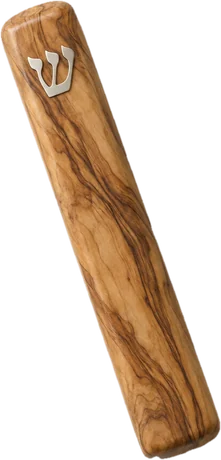
In conclusion, it is appropriate to leave some indication
that a concealed mezuza is present. An empty mezuza case would
serve this purpose.
Comments
Post a Comment